How to Get Daily HR News as a People Manager — Before Your First One-on-One
Published July 3, 2026
You learn about the new labor ruling from a LinkedIn comment. Not from your employment lawyer, not from an HR newsletter — from a stranger's hot take, three days late.
Good news — you're in the right place! 😊 There's a calmer way to stay ahead — it takes about two minutes to set up, and the first edition is free.
In this guide, I'll show you how to get daily HR news with MorningMail — a tool I built where an AI agent searches current sources every morning and writes the brief itself: legal changes, credible workplace research, pay-trend data.
So, let's get you set up.
What you'll build
HR is brutally jurisdiction- and size-dependent, and generic newsletters can't be. A works-council ruling is huge in Germany and irrelevant in Texas; a pay-transparency law binds a 500-person company and spares a 40-person one. Your prompt bakes country, headcount and industry into every edition — instead of leaving the filtering to you.
This isn't another keyword feed, either. Alerts forward anything that mentions "remote work", including the hundredth opinion column. MorningMail's agent searches the web fresh each morning, weighs what's actually new and credible, and writes you a few tight paragraphs — the actual bill text and the actual study linked, not a summary of a summary.
And your prompt keeps pace with the people cycle. Comp review? Have it watch salary benchmarks. Restructuring? Prioritise employment law. Each shift is one edited sentence — the brief changes the very next morning.
See it live: yesterday's edition
So here's a real example. This is yesterday's edition of exactly this newsletter — written by the agent yesterday morning, based on the example prompt from this guide. Not a mockup: I run it myself on MorningMail.
Edition from August 8, 2026
NLRB shifts labor enforcement, China AI compliance surge, merit shop contractors mobilize
NLRB leadership and enforcement tone
The NLRB's restored quorum signals a shift in labor-relations enforcement.
William B. Macy III and Scott Mayer Prouty's confirmations to the National Labor Relations Board in early 2026 have reset the Board's composition, potentially reshaping how precedents like Cemex and McLaren Macomb are interpreted [Quelle: ABC Ohio Valley]. Union organizing campaigns, unfair labor practice charges, and employer communication rules now face new interpretive pressure. Merit shop contractors in the tri-state region—Ohio, Kentucky, and Indiana—must audit employee handbooks, confidentiality clauses, and supervisor training to align with current precedent, tracking shifts from regional NLRB offices in Cincinnati and Indianapolis.
Right-to-work variance across states complicates compliance for multi-state operators.
China employment and AI compliance pressure
AI adoption is colliding with China's labor compliance expectations.
Employers navigating the Chinese employment landscape face rising disputes around harassment, discrimination, and AI-driven workforce decisions, requiring faster internal investigations and accessible reporting channels [Quelle: JD Supra]. Alternative labor models—outsourcing and labor dispatch—gain traction under cost pressure but demand careful regulatory compliance to avoid legal and reputational risk. Simultaneously, China's gradual extension of statutory retirement age is reshaping workforce planning and succession strategy, with downstream implications for benefits and retirement costs.
Organizations with China operations now face a triple squeeze: technology risk, dispute surge, and pension redesign.
Merit shop contractors' NLRB playbook
Merit shop contractors need a fresh NLRB compliance calendar.
Front-line supervisors require updated training on labor-relations fundamentals and union-communication rules; employee handbooks must be reviewed quarterly as Board decisions shift [Quelle: ABC Ohio Valley]. Clear escalation protocols for handling union-related communications on jobsites limit exposure. Contractors operating across Ohio, Kentucky, and Indiana must coordinate compliance with state-specific right-to-work provisions and monitor organizing-activity signals across the tri-state region.
Quarterly decision reviews and regional office guidance tracking are now baseline defenses.
 Merit Shop Leadership and Labor Policy - ABC Ohio Valley20 hours ago ... ... comply with current laws. HR owns policy updates and training. Project managers and superintendents ensure consistent practices across jobsites. Foremen and ...ovabc.org
 The Future Of Work In China: Key Employment Trends In 2026 And ...22 hours ago ... AI adoption, rising workplace disputes, evolving labor models and retirement reform ... Employment Policies. + Follow x Following x Following - Unfollow. Hiring ...jdsupra.com
One click creates your own editable copy — change the prompt, the delivery time, everything.
Browse all editions →You could get this general version into your inbox right now — and then fine-tune it to your very specific needs. Here's how to do it:
Step by step: from zero to your first edition
The whole setup takes about two minutes. And every screenshot below comes straight from the real product — nothing is mocked up.
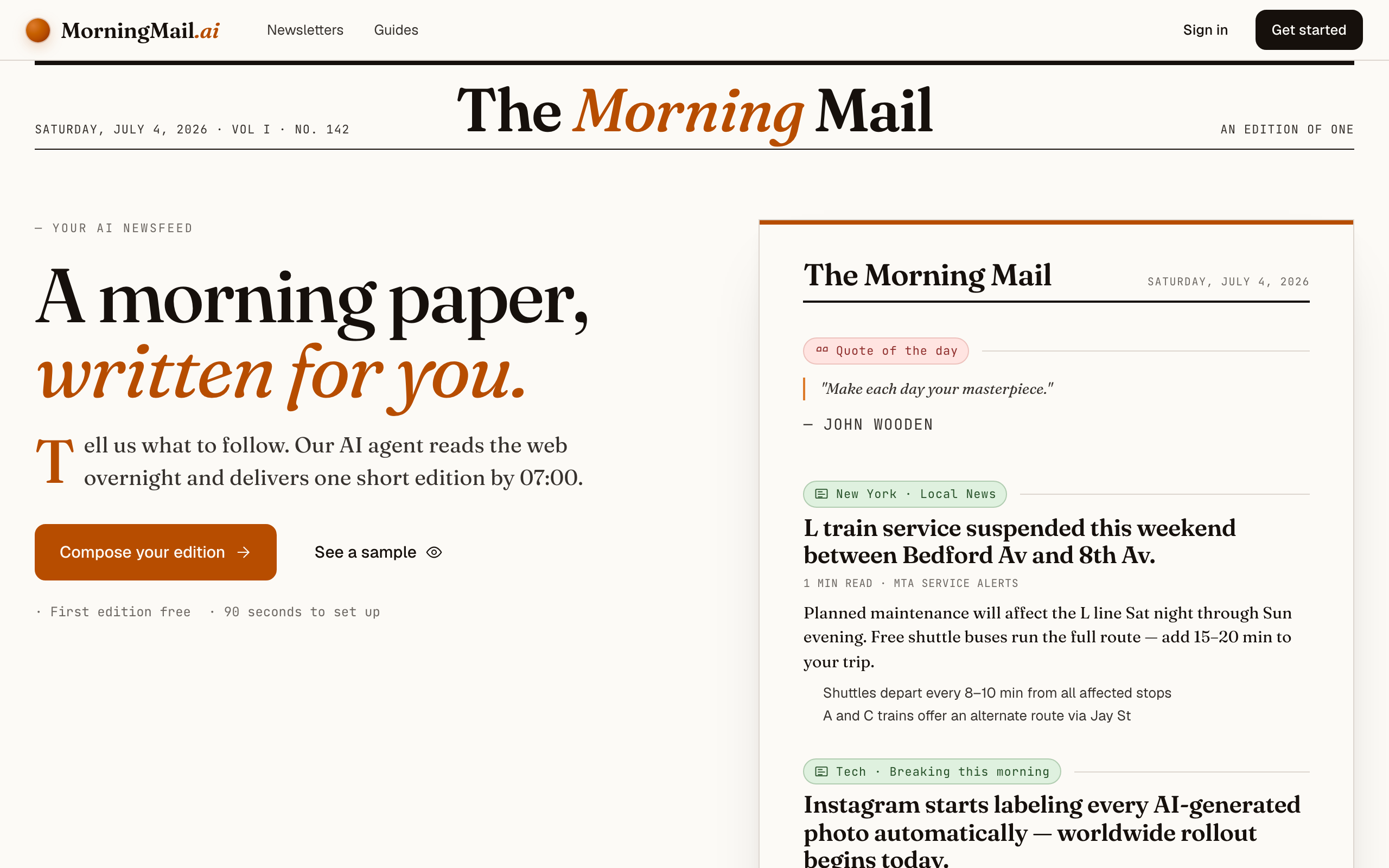
Step 1 Open morningmail.ai
Head over to morningmail.ai. You'll see a sample edition and the Compose button — that's your entry point. Nothing to install; everything runs in the browser.
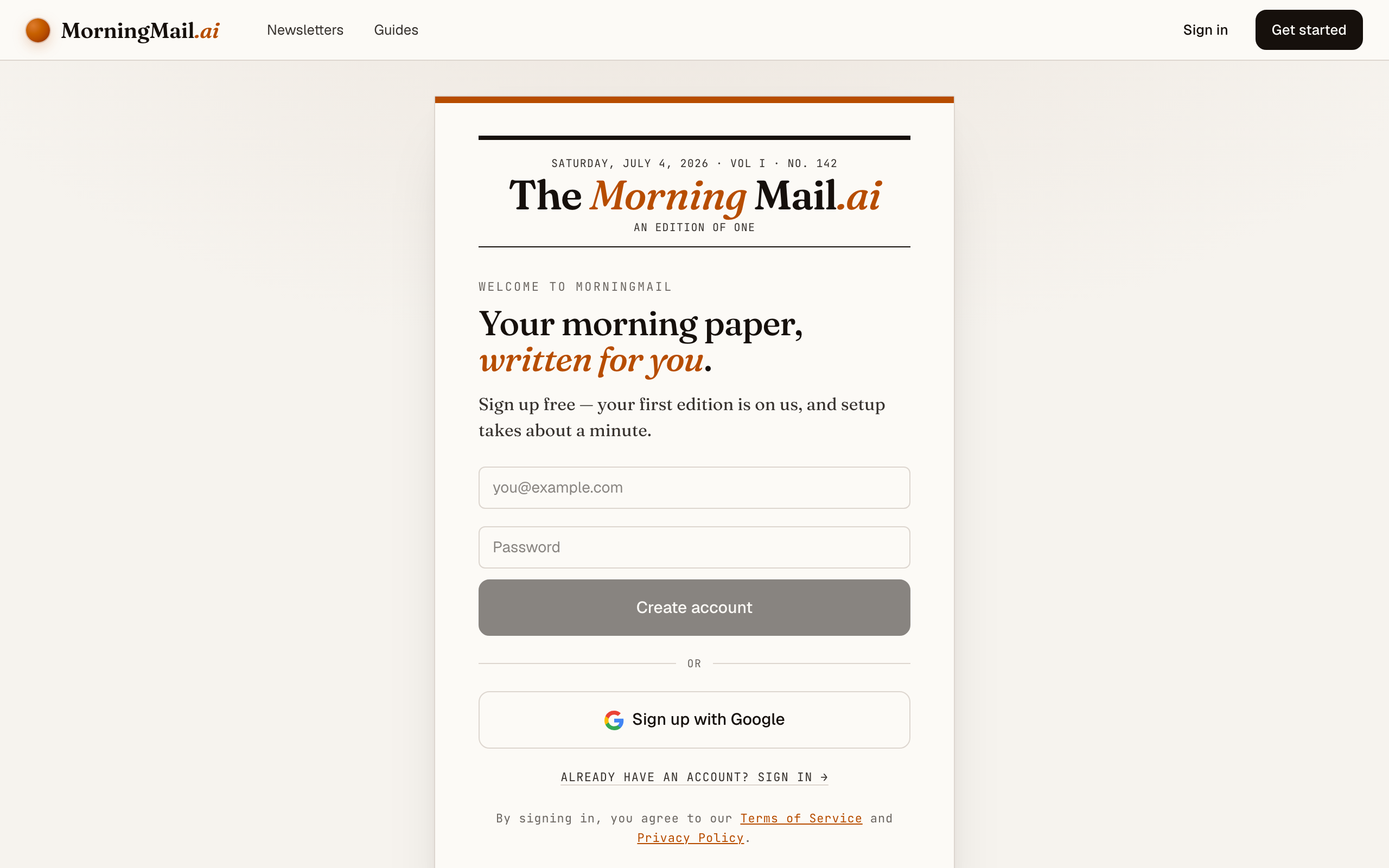
Step 2 Create your free account
Sign up with your Google account. Every new account comes with a free first edition built in — so you can send yourself a real email before paying a cent.
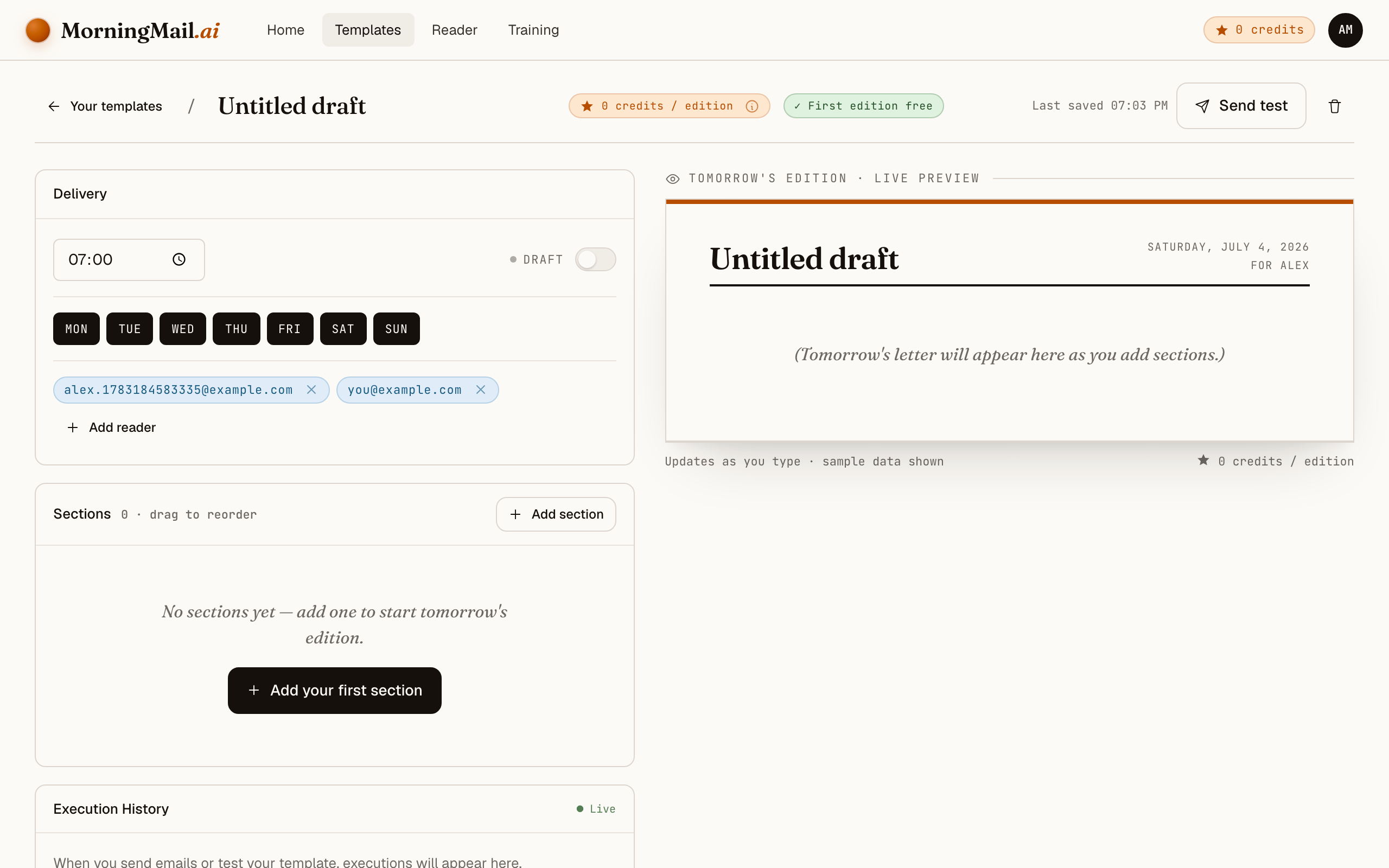
Step 3 Create your first template
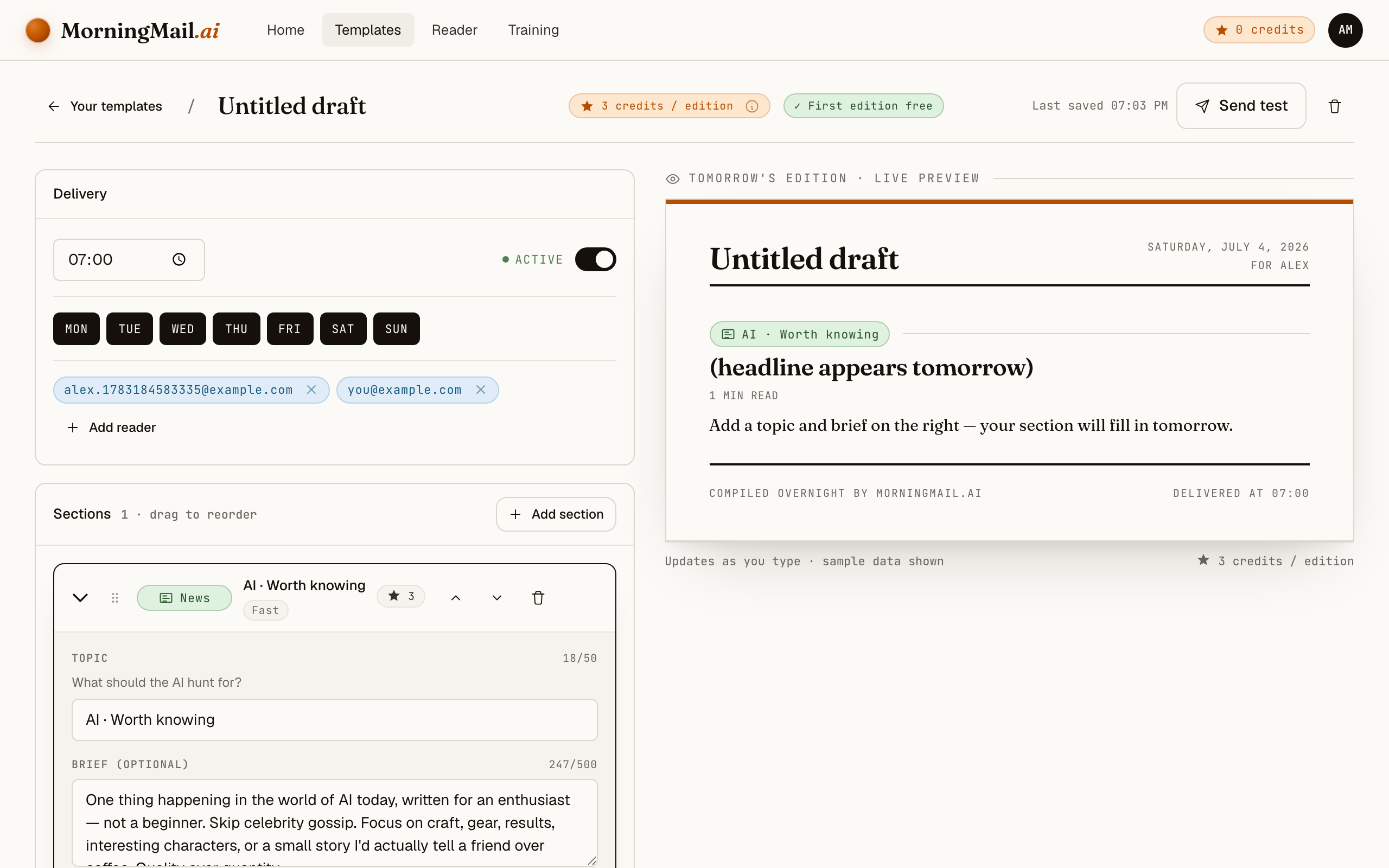
A template is the blueprint of your email: name, delivery time, recipients, and your content sections. Click "New template" and the builder opens with a live preview right next to the editor. Everything saves automatically — there is no save button to forget.
Step 4 Add a news section
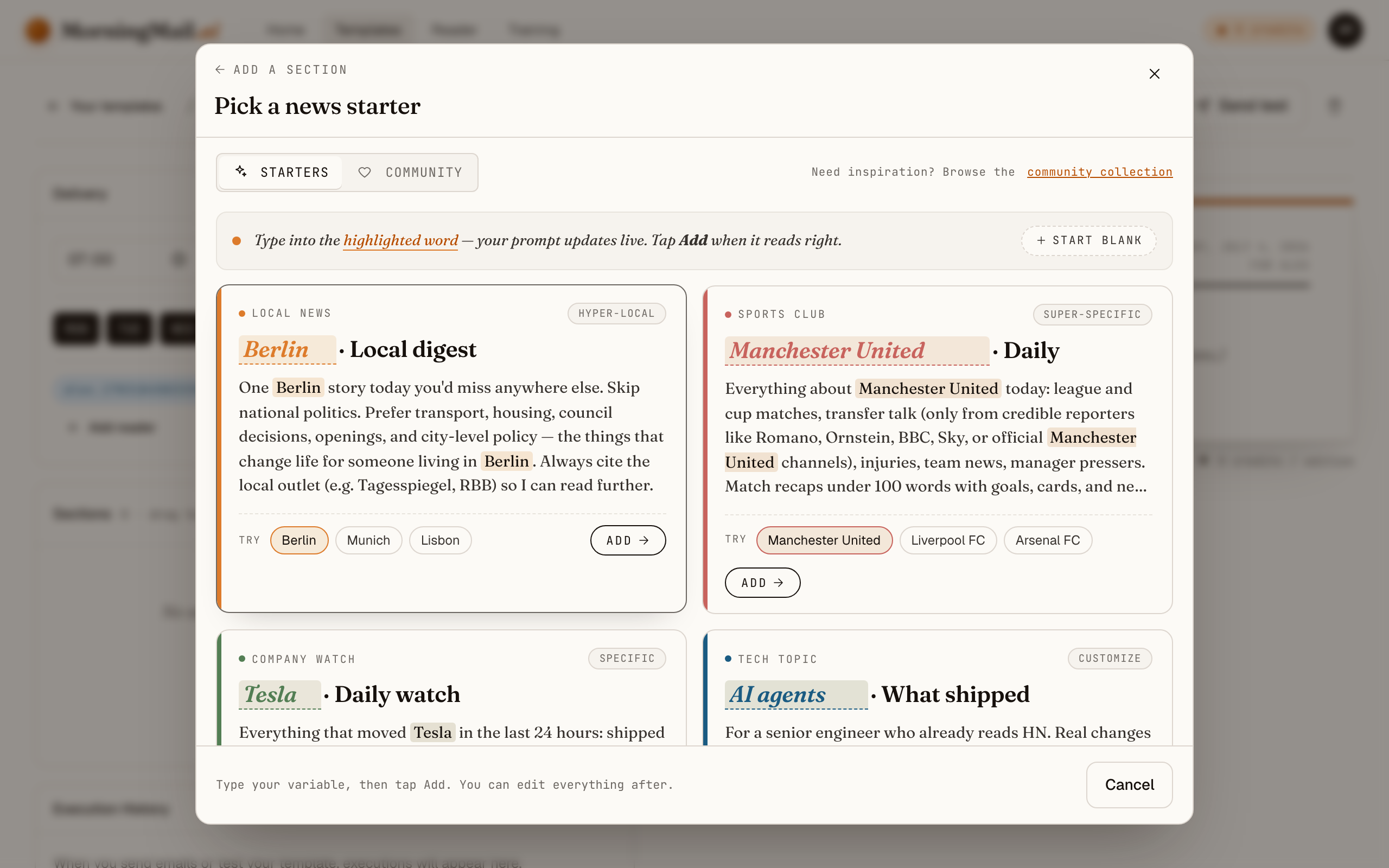
Click "Add section +" and pick "News topic". You'll see six starters — real, editable prompts for a city, a sports club, a company, a tech topic, a professional field, and a personal interest. Pick one, and you're thirty seconds away from a working brief.
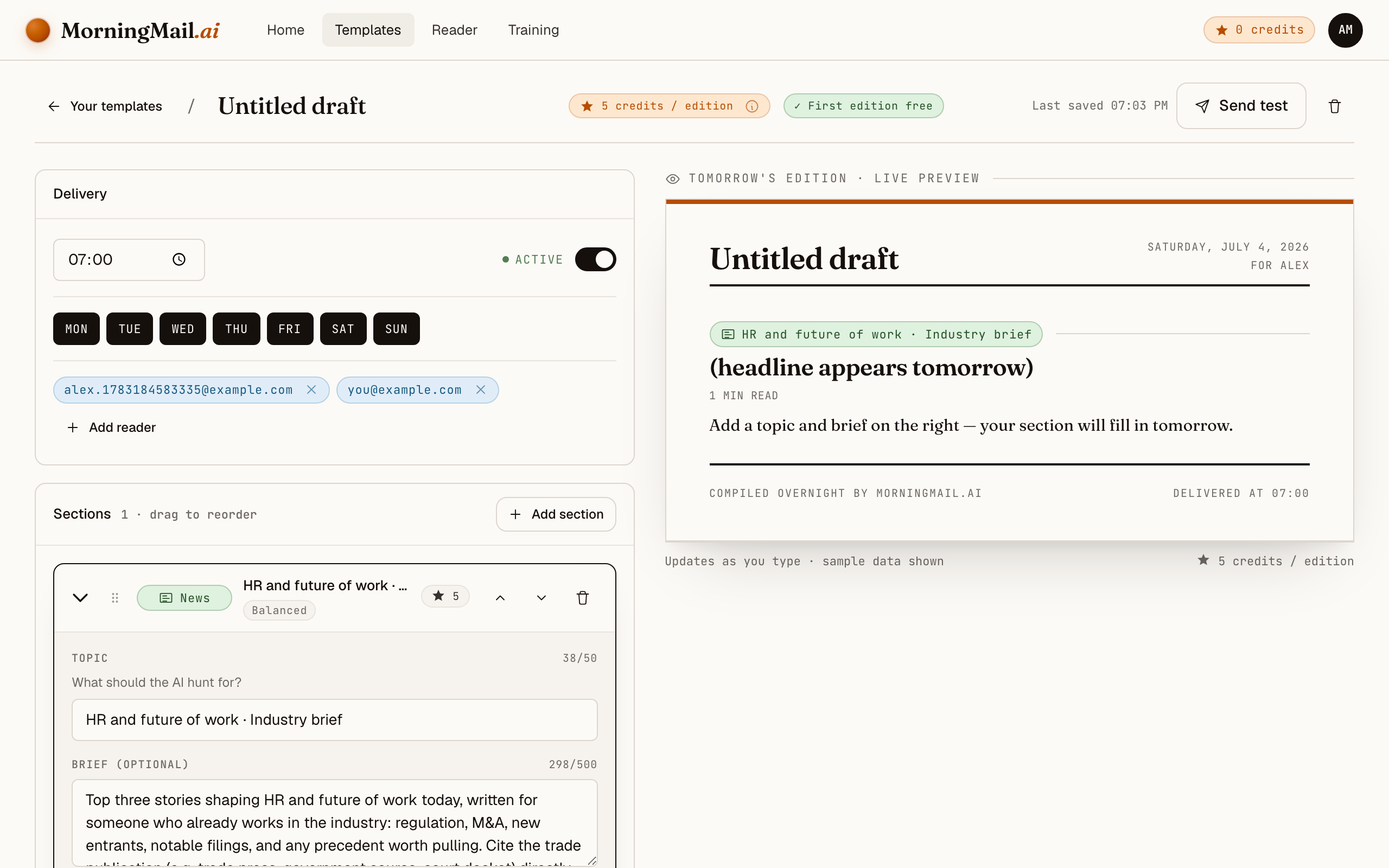
Step 5 Make it yours: HR and future of work
In the module picker, choose the "Professional brief" starter card and type HR and future of work into the highlighted field. As you type, the card rewrites its prompt around your words in real time — the instruction your agent runs each morning is never a black box.
The default asks for three stories that shape your field, written for a practitioner, every claim cited to trade press or government sources. One sentence of context makes it yours, for example: "Prioritise labor-law changes and credible remote-work research relevant to a 60-person software company with staff in the US and Germany; include one compensation data point when material."
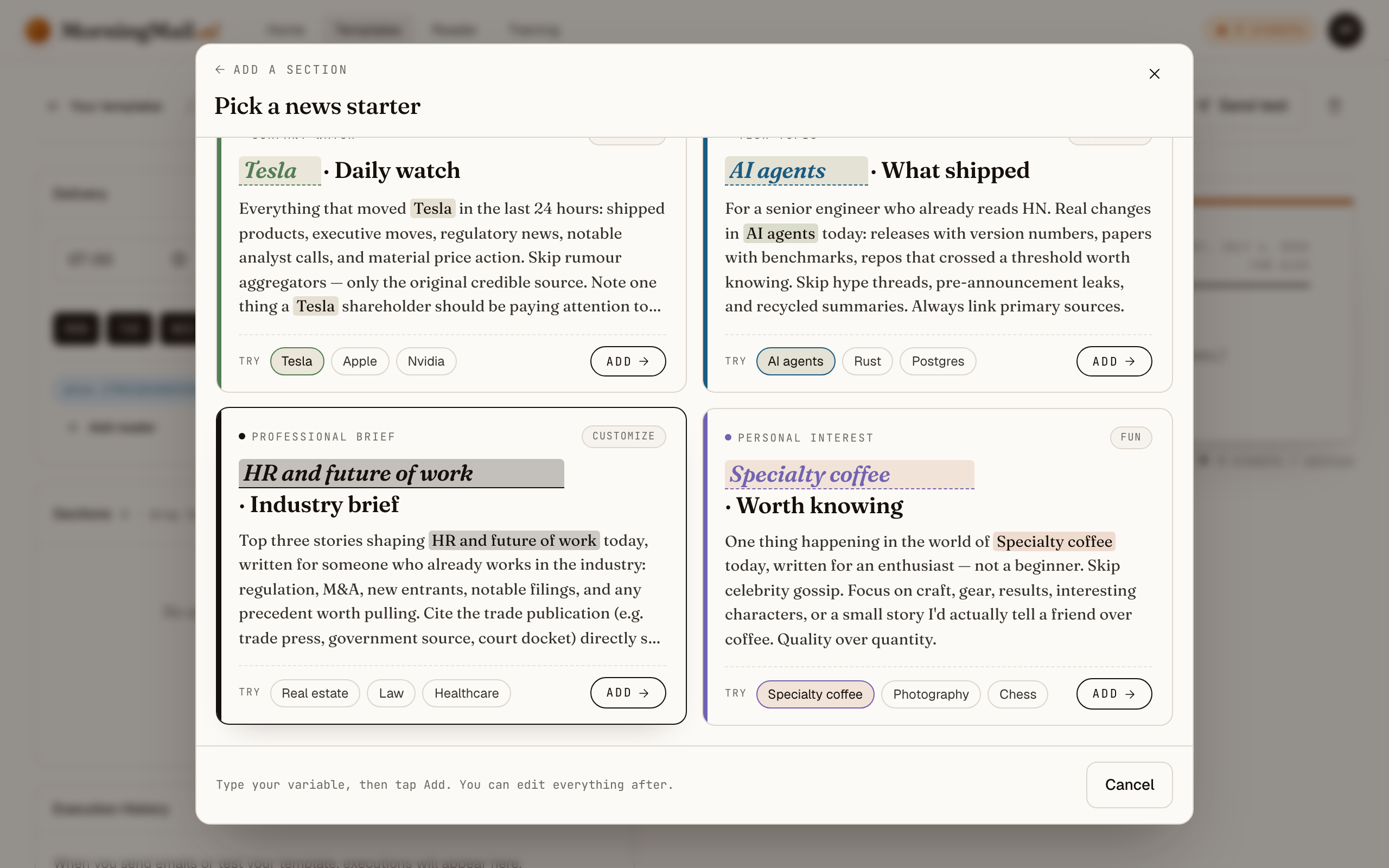 The exact prompt your section starts with
Top three stories shaping HR and future of work today, written for someone who already works in the industry: regulation, M&A, new entrants, notable filings, and any precedent worth pulling. Cite the trade publication (e.g. trade press, government source, court docket) directly so I can follow up.
Step 6 Set your delivery time and send yourself a test
Almost there! Choose when the email should arrive and add your address as a recipient. Hit "Send test" — your first edition is free — and check your inbox. If something reads off, tweak the prompt and send again. Then flip the template to Active. Congratulations — you've just built your own morning brief!
Get more out of your brief
- Anchor the brief to your jurisdictions
- Employment law doesn't travel. List the countries or states where you actually employ people — "we hire in Germany, the Netherlands and New York" — and the agent stops burying you in rules you'll never have to comply with.
- Ask for the effective date, every time
- Have the agent state when a legal change takes effect and who it covers. "New pay-transparency rules" is a headline; "applies to employers with more than 100 employees from January 1" is a to-do you can schedule.
- Insist on studies over takes
- Future-of-work discourse is nine parts opinion. Add "prefer peer-reviewed research and large-sample surveys; name the sample size" to your prompt — suddenly the hybrid-work debate arrives with evidence attached.
- Give the leadership team its own copy
- Templates support multiple recipients, so the same morning email reaches you and your leadership peers. A shared factual baseline shortens the buy-in conversation when a legal change demands action.
- Pair it with a calendar section
- Your template can hold more than news: add a calendar section so the brief opens with today's interviews and one-on-ones, or a TLDR that compresses everything into three bullets. Per-section length and tone settings keep it under two minutes of reading.
Good sources to anchor your brief on
The agent searches the open web every morning and cites where it read things. These are the sources I'd point it at in your prompt:
- SHRM — The largest HR professional body — its news desk and compliance resources are the standard first stop for US employment-law changes and workplace-policy shifts.
- HR Dive — Daily trade journalism on people management — court decisions, agency rules and employer moves, reported quickly and with sources.
- Josh Bersin's research and blog — The most-followed independent analyst on HR technology and workforce trends — useful for separating durable shifts from vendor-driven hype cycles.
- European Commission — Employment, Social Affairs & Inclusion — The primary source for EU directives on working conditions, pay transparency and platform work — the upstream origin of much national legislation.
- Harvard Business Review — Managing people — Evidence-based writing on management practice — when a people question escalates to your executive team, this is the shared vocabulary the discussion uses.
- WTW and Mercer compensation studies — The benchmark surveys behind most salary-band decisions. Their release announcements move counteroffers months before they show up in your applicant pool.
Frequently asked questions
- What will this cost me?
- The first edition is free, no credit card. After that each send costs credits — a few per section, depending on the AI model tier you choose — and credits never expire. A quiet hiring-freeze month wastes nothing.
- Isn't Google Alerts enough for tracking HR topics?
- Alerts hand you every page matching your keywords, unranked and unread — vendor blogs next to actual statutes. The brief flips that: the agent researches each morning, filters for what's new and credible, and writes a summary with primary sources linked. You read conclusions, not search results.
- Can the brief track labor law for multiple countries?
- Yes — name the countries in your prompt and the agent covers them together each morning. Managers with distributed teams often list two or three jurisdictions and ask for effective dates on every legal item.
- We're a small company. Is most HR news even relevant to us?
- That's precisely what the prompt solves: state your headcount and the agent skips rules that only bind large employers. One sentence — "we're 45 people, ignore obligations that start at 250+" — removes most of the noise.
- Can I get it weekly instead of daily?
- Yes — delivery time and weekdays are configurable per template. A Monday-morning edition covering the week ahead is a popular pattern for people managers whose news load doesn't justify a daily send.
Your inbox, your editor
Build your own AI-written brief in two minutes. The first edition is on me — no credit card required.
Build your brief — freeI am always happy to answer questions and I'm open to feedback. Feel free to reach out at any time: marius@morningmail.ai