How to Get Daily Marketing News as an E-Commerce Founder — Without Losing Your Morning
Published July 3, 2026
It's 7 a.m., and Meta changed its ad rules overnight — again. Your Advantage+ campaigns are already spending against a policy you haven't read yet.
Good news — you're in the right place! You can replace that morning scramble with one short email. Setup takes about two minutes, and the first edition is free.
In this guide, I'll show you how to get daily marketing news for your store with MorningMail — a tool I built where an AI agent searches the web every morning and writes the brief itself: ad-platform changes, SEO updates, consumer signals.
So, let's dive in — it's really easy! 😊
What you'll build
Generic marketing newsletters are written for everyone, which means they're written for no one. A bit of B2B, a bit of brand gossip — and the two paragraphs that actually concern your store buried somewhere in the middle. You need the opposite: depth on the channels that drive your revenue, silence on the rest.
Couldn't Google Alerts do that? Honestly — no. An alert just forwards links that match a keyword, press releases and SEO spam included. MorningMail's agent searches fresh sources every morning, weighs what actually changed, and writes the email itself — full sentences, every claim linked to its source so you can verify before you act.
And your prompt carries your context permanently. Tell it once that you run a home-goods store on Shopify, and every future edition already knows. Launching in France next quarter? Add one line. That's all the upkeep there is.
See it live: yesterday's edition
So here's a real example. This is yesterday's edition of exactly this newsletter — written by the agent yesterday morning, based on the example prompt from this guide. Not a mockup: I run it myself on MorningMail.
Edition from August 8, 2026
DSA enforcement spreads, UK ad rules tighten, Ukraine retail merges
EU DSA enforcement expands
Europe's Digital Services Act is moving beyond AliExpress into ad fraud prevention.
The European Commission fined AliExpress €550 million in July for failing to mitigate counterfeit and unsafe products, establishing that platform risk controls must work upstream—not just reactive takedowns [Source: TechPolicy.Press]. Preliminary findings against Meta and TikTok signal similar enforcement pressure on minor protection and content moderation. The pattern is clear: fines alone don't change behavior; structural redesigns now follow.
Platforms face mounting pressure to prove real-time risk architecture, not compliance theater.
UK mandates ad fraud detection
Ofcom's new fraudulent advertising code turns detection into a legal duty.
The UK regulator adopted a register of regulated services and opened consultation on a Fraudulent Advertising Code of Practice requiring Category 1 platforms (Facebook, Instagram, TikTok, YouTube, X) and Category 2A search engines to deploy risk-based systems for ad fraud detection, maintain searchable ad libraries, and increase moderation transparency [Source: TechPolicy.Press]. Compliance demands enforcement timelines and audit trails tied to platform liability. This follows earlier state-level pricing crackdowns.
Brands must audit which platforms meet this standard before Q4 campaign launches.
Varus acquires Kolo in Ukraine
Ukrainian supermarket consolidation accelerates with a 254-store acquisition.
Varus completed its purchase of convenience chain Kolo in August, expanding its network to 374 locations across Kyiv, Odesa, and surrounding regions after regulatory approval on July 16 [Source: Inventure]. Kolo stores retain their brand initially while Varus consolidates logistics, procurement, digital services, and loyalty programs—a classic integration playbook. The move mirrors post-war regional consolidation across Eastern Europe's retail sector.
Watch for similar deals as retailers rebuild scale in contested markets.
 Global Digital Policy Roundup: July 2026 | TechPolicy.Press8 hours ago ... China's State Administration for Market Regulation and Ministry of Commerce opened a consultation on amendments to the E-commerce Law. It includes measures ...techpolicy.press
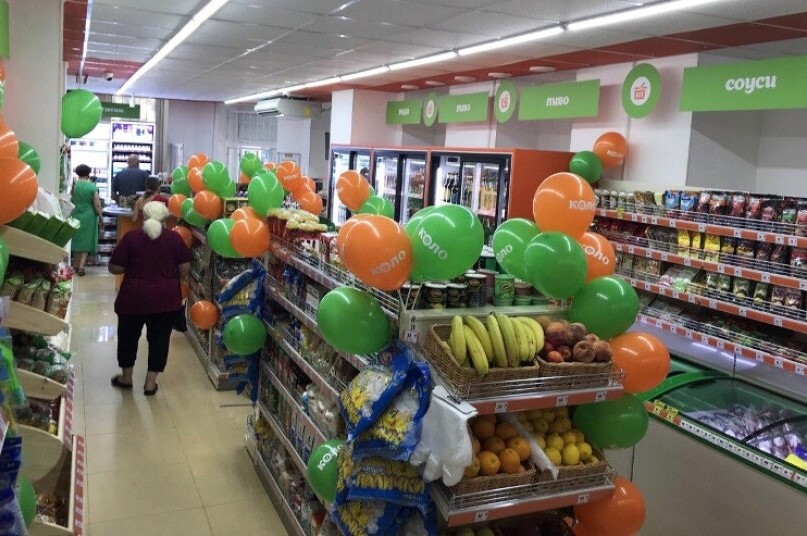 Varus Completes Acquisition of Kolo Convenience Store Chain ...15 hours ago ... ... M&A deals news. Views icon. 97. Supermarket chain Varus, owned by entrepreneurs ... retail market in 2026 and reflects the continued consolidation of the ...inventure.com.ua
One click creates your own editable copy — change the prompt, the delivery time, everything.
Browse all editions →You could get this general version into your inbox right now — and then fine-tune it to your very specific needs. Here's how to do it:
Step by step: from zero to your first edition
The whole setup takes about two minutes. And every screenshot below comes straight from the real product — nothing is mocked up.
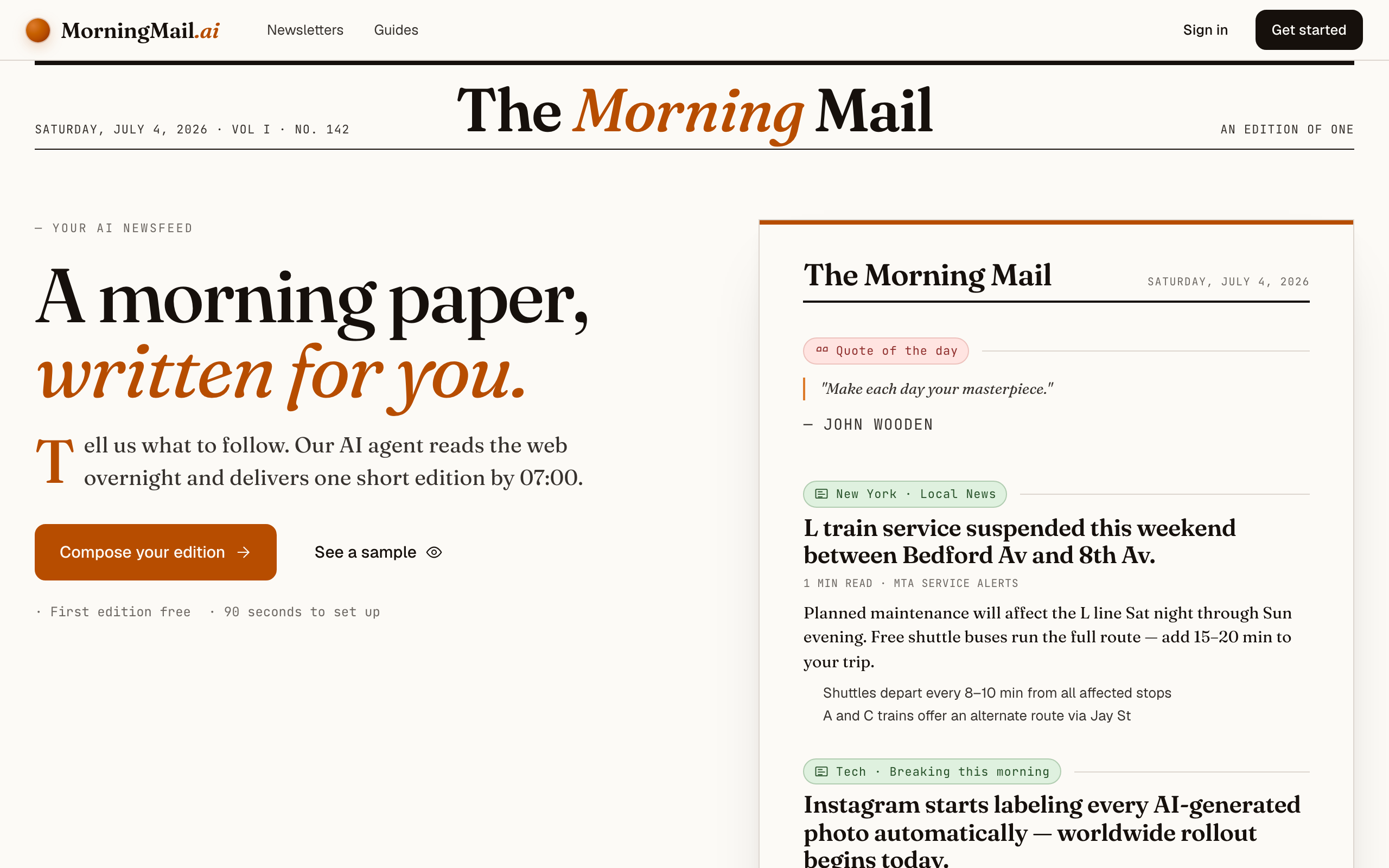
Step 1 Open morningmail.ai
Head over to morningmail.ai. You'll see a sample edition and the Compose button — that's your entry point. Nothing to install; everything runs in the browser.
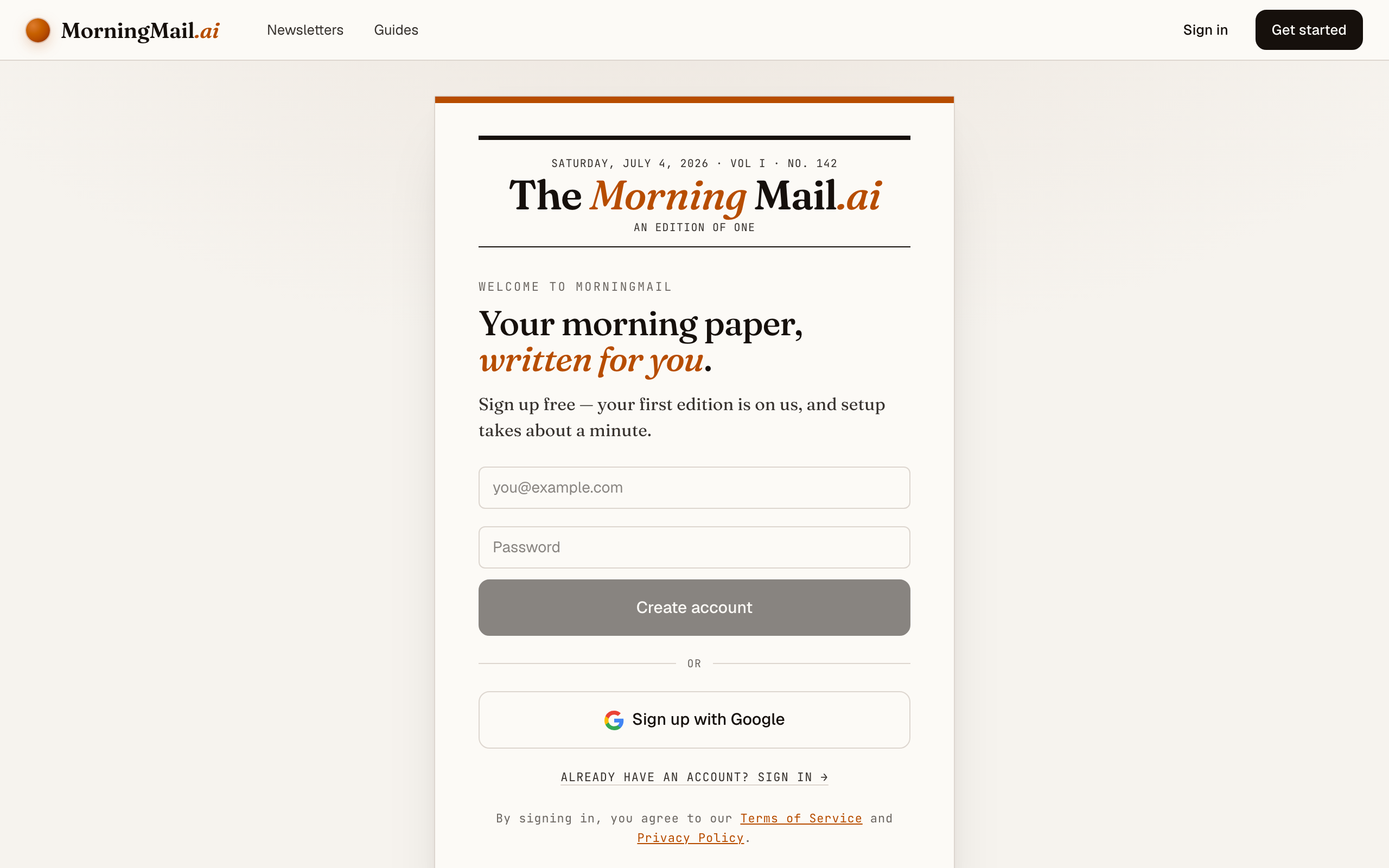
Step 2 Create your free account
Sign up with your Google account. Every new account comes with a free first edition built in — so you can send yourself a real email before paying a cent.
Step 3 Create your first template
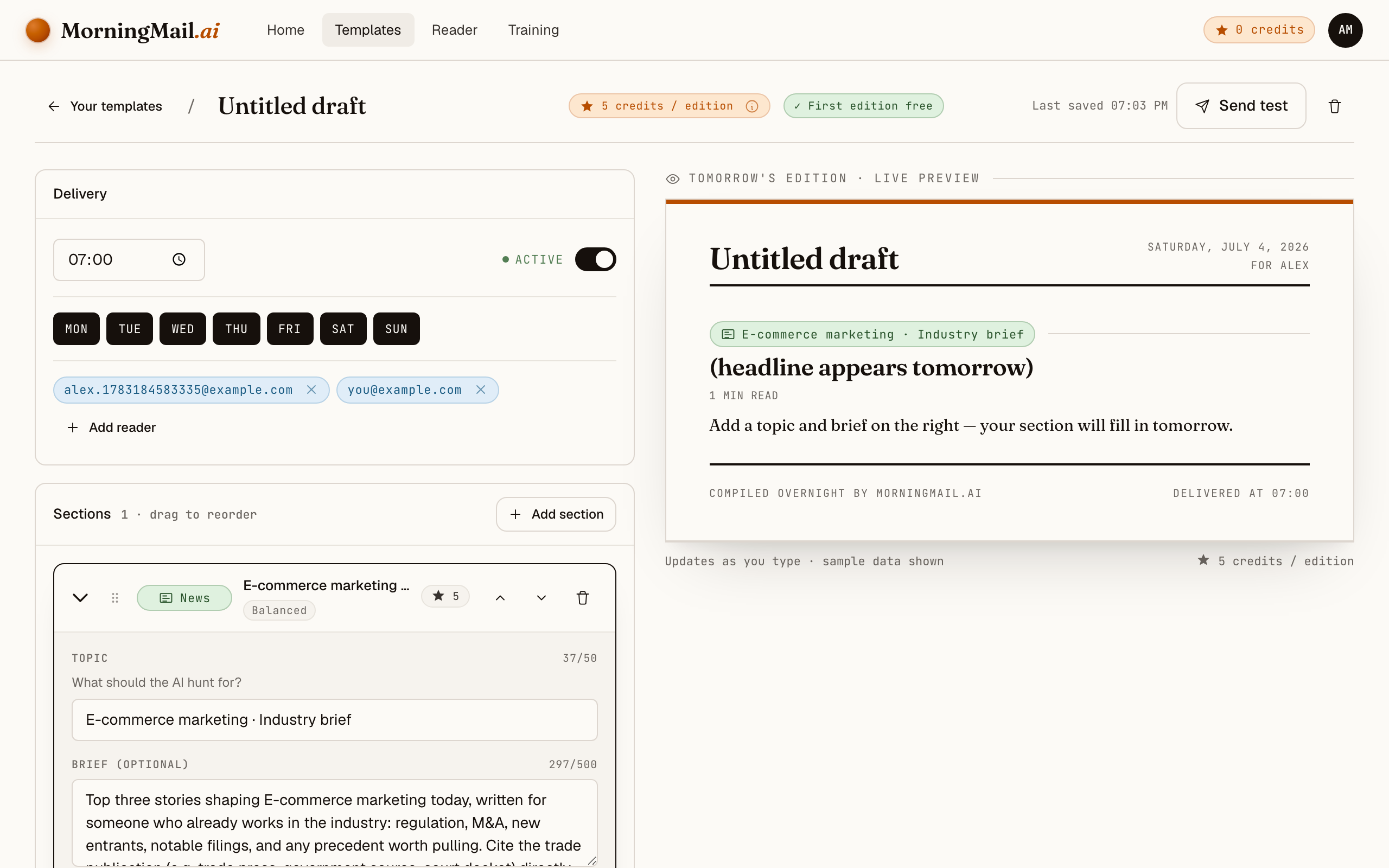
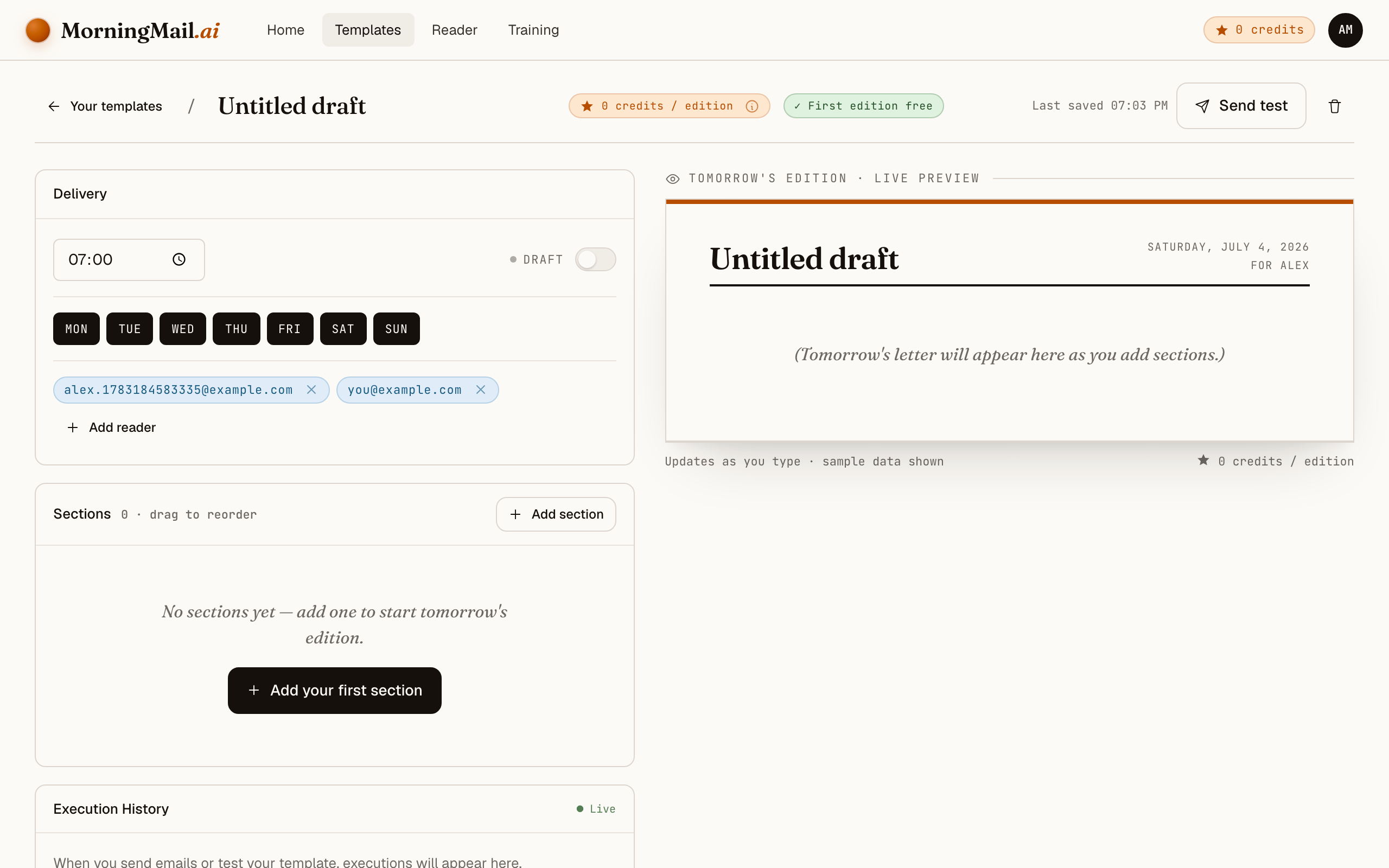
A template is the blueprint of your email: name, delivery time, recipients, and your content sections. Click "New template" and the builder opens with a live preview right next to the editor. Everything saves automatically — there is no save button to forget.
Step 4 Add a news section
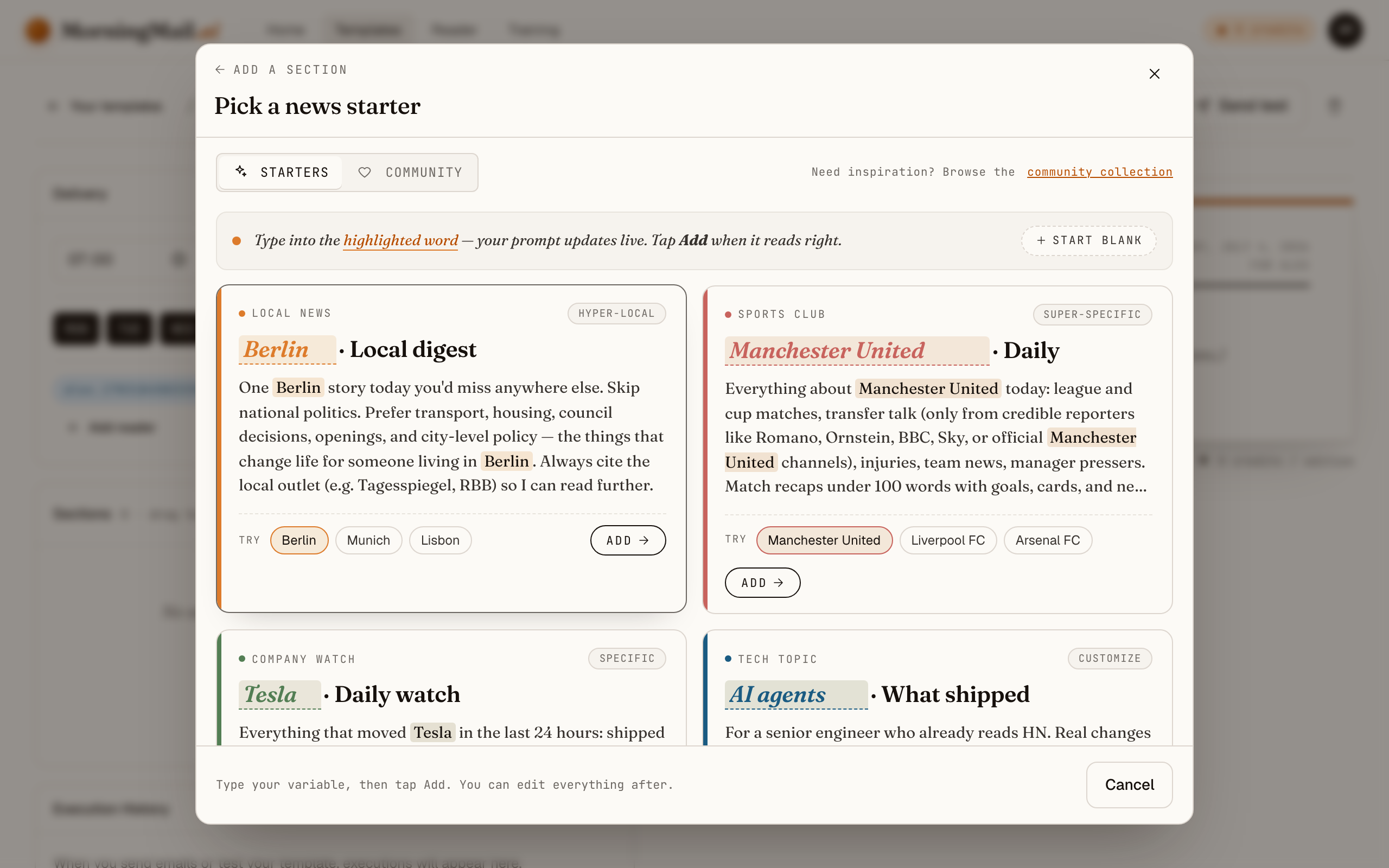
Click "Add section +" and pick "News topic". You'll see six starters — real, editable prompts for a city, a sports club, a company, a tech topic, a professional field, and a personal interest. Pick one, and you're thirty seconds away from a working brief.
Step 5 Make it yours: E-commerce marketing
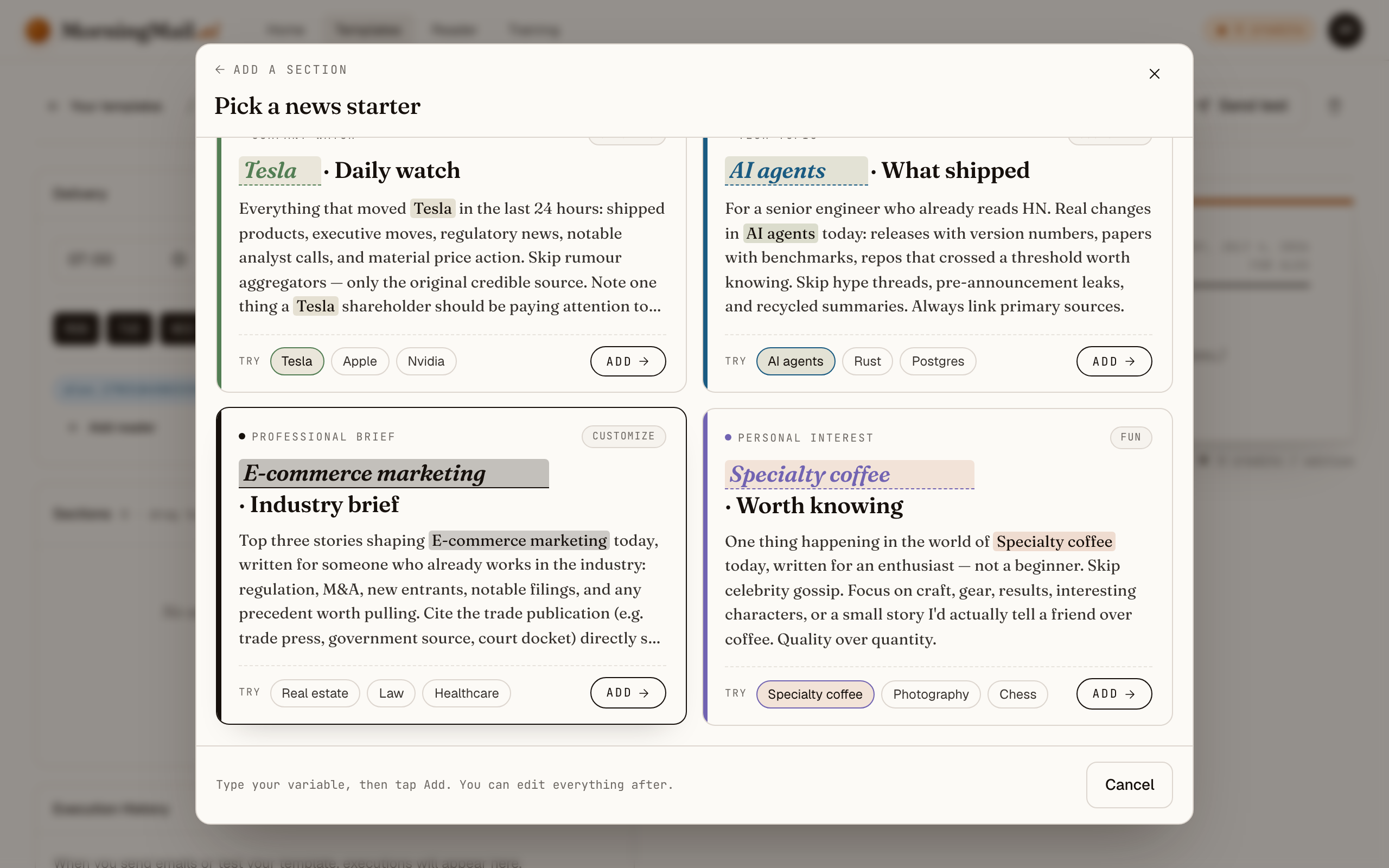
Here's the setup: in the module picker, select the "Professional brief" starter card and type E-commerce marketing into the highlighted field. The card rebuilds its prompt live around your entry — you watch the exact instruction your agent will run every morning, before you save anything.
The default prompt is already opinionated: the three biggest stories, written for an insider, cited straight from the trade press. It gets properly sharp once you add your reality, for example: "Focus on Google and Meta ad-platform changes, search updates that affect product pages, and consumer-spending signals for European D2C brands. Skip agency awards and thought-leadership pieces."
 The exact prompt your section starts with
Top three stories shaping E-commerce marketing today, written for someone who already works in the industry: regulation, M&A, new entrants, notable filings, and any precedent worth pulling. Cite the trade publication (e.g. trade press, government source, court docket) directly so I can follow up.
Step 6 Set your delivery time and send yourself a test
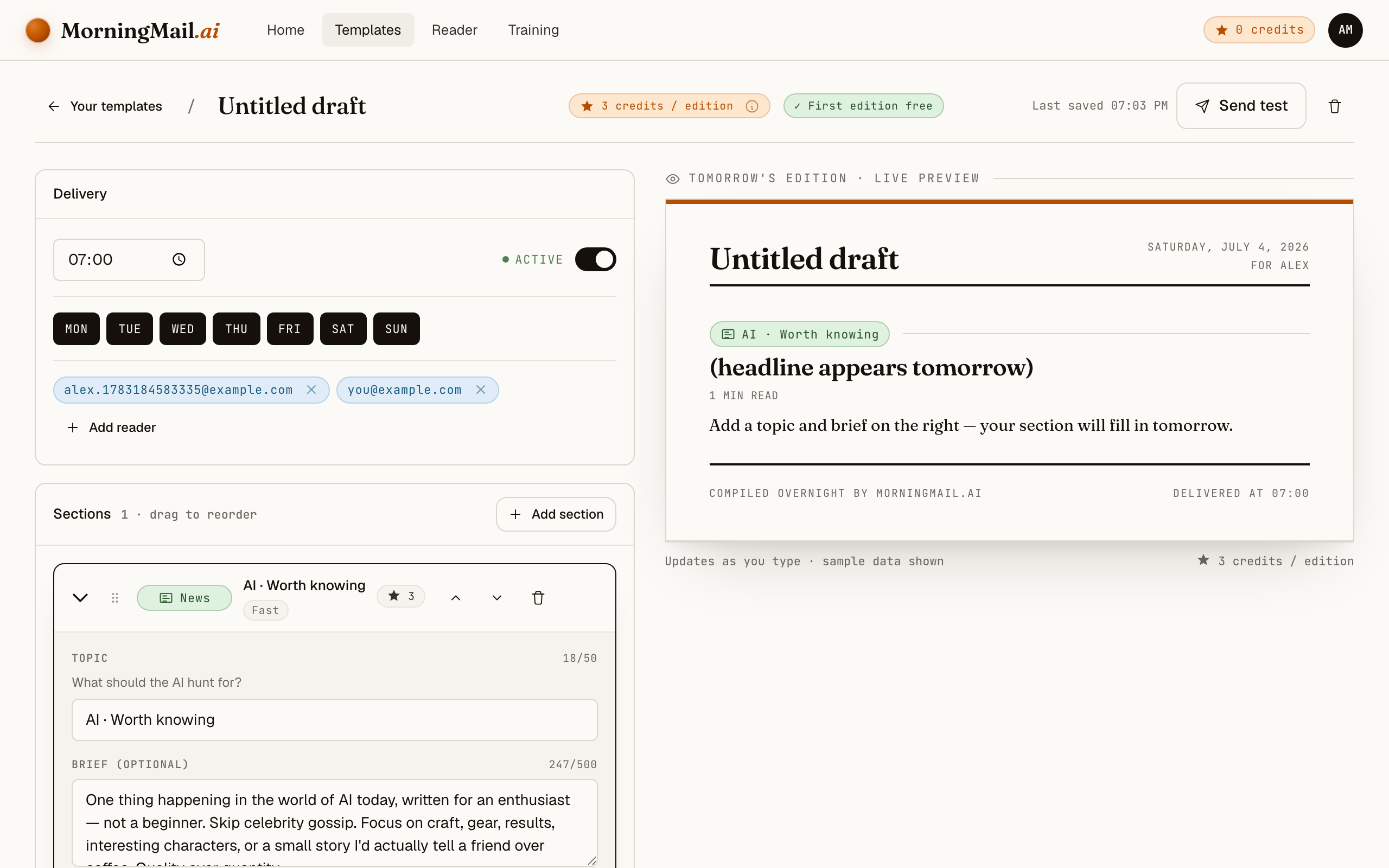
Almost there! Choose when the email should arrive and add your address as a recipient. Hit "Send test" — your first edition is free — and check your inbox. If something reads off, tweak the prompt and send again. Then flip the template to Active. Congratulations — you've just built your own morning brief!
Get more out of your brief
- Name your channels, not just your industry
- "E-commerce marketing" gets you breadth. "Meta ads, Google Shopping, email flows and organic search for a home-goods store" gets you a brief that reads like it came from your own team. The agent prioritises exactly what you tell it to — nothing more.
- Ask for changes, not trends
- Trend listicles are the junk food of marketing media. Tell the agent to report what changed — ad policies, auction mechanics, fees, ranking systems. A change demands a decision this week; a trend mostly demands anxiety.
- Match the cadence to the channel
- Your template lets you pick the delivery time and the exact weekdays. Ad platforms move daily; consumer research doesn't. My favourite pattern: the marketing brief Monday to Friday, plus one section that digs into consumer trends once a week.
- Put a TLDR on top for packing days
- Add a TLDR section that condenses the whole email into three bullets at the top. On packing days you read the bullets, on planning days everything — same email, two speeds.
- Send it to your co-founder too
- Templates support multiple recipients, so whoever runs your ads reads the same brief you do — shared input beats forwarded screenshots. And if your section turns out great, publish it to the community gallery for other founders to subscribe to.
Good sources to anchor your brief on
The agent searches the open web every morning and cites where it read things. These are the sources I'd point it at in your prompt:
- Google Search Central Blog — Google's own channel for algorithm updates, Search Console changes and structured-data requirements — the primary source behind every "Google update" panic post, minus the panic.
- Meta for Business announcements — Where ad-product changes, targeting deprecations and policy updates land first. If your acquisition runs through Instagram or Facebook, this is the source your brief should quote.
- Search Engine Land — Daily trade coverage of search and paid media — fast, sourced reporting on platform changes whenever Google's own posts stay vague.
- Practical Ecommerce — Tools, conversion and operations written for merchants rather than agencies — rare and valuable in a space full of vendor content.
- Think with Google — Google's consumer-insights research: seasonal demand curves, category trends and shopping behaviour you can actually plan inventory against.
- Shopify Blog & Changelog — Platform updates and merchant case studies. If your store runs on Shopify, the changelog alone is worth watching — features appear there before the marketing does.
Frequently asked questions
- How much does a daily marketing brief cost?
- Your first edition is free — no credit card required. After that you pay per send with credits: each section costs a few, depending on the AI model tier it runs on. And credits never expire, so a slow month costs you nothing.
- Why not just set up Google Alerts for my niche?
- Because alerts forward whatever matches a keyword — you still open, skim and judge every link yourself. MorningMail inverts that: the agent reads fresh sources each morning, discards the noise and writes you a short memo with linked sources. You keep the judgement, lose the tab-hopping.
- Can the brief focus on my specific niche, like fashion or supplements?
- Yes — that's exactly why you write the prompt yourself. Mention your category, your market and your channels, and every morning's research is filtered through them. The more specific you get, the less generic the brief.
- I don't need marketing news daily. Can I get it weekly?
- Sure — you pick the weekdays per template, so a Monday-only send works just as well as a daily one. Many founders go daily during a launch and drop to twice a week once things settle.
- Does the brief work in languages other than English?
- Yes — the agent writes in the language of your prompt. Instructions in French get you a French brief. The interface itself is available in English and German.
Your inbox, your editor
Build your own AI-written brief in two minutes. The first edition is on me — no credit card required.
Build your brief — freeI am always happy to answer questions and I'm open to feedback. Feel free to reach out at any time: marius@morningmail.ai